Showing posts with label airplane. Show all posts

Thursday, April 15, 2010

Receding Airline

      It happened as I sat wedged in my narrow, cramped airline seat, pondering whether to eat my four peanuts all at once or string them out to prolong the pleasure. I came to the sudden realization that I had been lied to. Looking back on the day's long lines, embarrasing security measures and extra bag fees it occurred to me that my entire generation had been sold a bill of goods. We "Baby Boomers" were told that our standard of living would be better than that of our parents. As the World's dominant power our nation would naturally be so prosperous we would be swept up in a rising tide of wealth. Somehow it hasn't worked out that way.
   Sure we have iphones and flat-screen TVs, but in the ways that count, I wonder if our quality of life has actually gone down? There are many examples of how the food we eat, the products we buy and even the way we travel are inferior to those of the past. One of the most obvious is air travel, which sadly, has become something you have to endure to get where you want to go.
   Let's take a flight of fantasy and look back at a more "primitive" time before anyone had ever heard of levereged buyouts or marketized securities and airlines promised to take us into that brave new future.

In the early days of commercial aviation the airlines would roll out the red carpet for their pampered passengers.

It was nice of the airport to let Timmy's family (and their dog) out onto the runway to see their daddy off.

This 1929 passenger plane could hold 14 people and two pilots.

No air-conditioned hydraulic jetways in those days. You just walked out onto the field and climbed in.

When American Airlines introduced the Condor in 1933, it became the nation's first sleeper plane.

Buckminster Fuller once pointed out that whenever a new technology is introduced, people tend to treat it the same way as the technology it replaced. This Boeing 307 berth was clearly using a railroad model but the airlines learned early on that space was too valuable to waste to let people stretch out horizontally.

Flight deck of a 1941 passenger plane.

While railroads made it easy to see the country, airplanes seemed to make it easy see the world.

Fairly-cramped interior of a Boeing plane of 1933.

TWA had a pretty snazzy lounge in this 1950s plane.

Early view of Miami International Airport.

These 1930 stewardesses got to wear stylish capes as airlines began to compete over who could offer the best passenger amenities.

This interior of a Douglas DC-7 Cabin is more recognizable to modern flyers but note how much more individual space there is even in coach class. Travel was so special, people dressed up for it. Every man in the picture has a tie and the woman in yellow obviously added a corsage just for the flight.
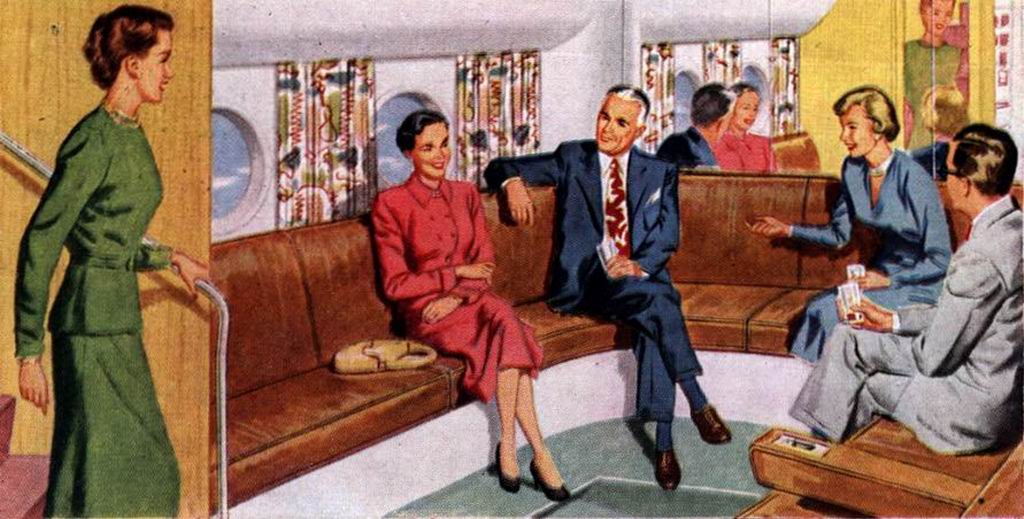
Just like the trains, the larger passenger planes had lounges where one could get drinks served in a casual environment.

It's interesting that this is an ad from a manufacturer, not an airline.

This swinging singles airplane lounge has it all: mini-skirted stewardesses with Bride-of-Frankenstein hairdos and George Jetson furniture Where is the seat belt on that chair?

This BOAC (British Overseas Airways Corporation) ad assures the passenger that they can always rely on the courteous cabin staff to recommend the appropriate wine.

This Canadian airline served a full-course meal, including fresh fruit.

Even when airlines did serve meals I don't remember seeing anything like this!
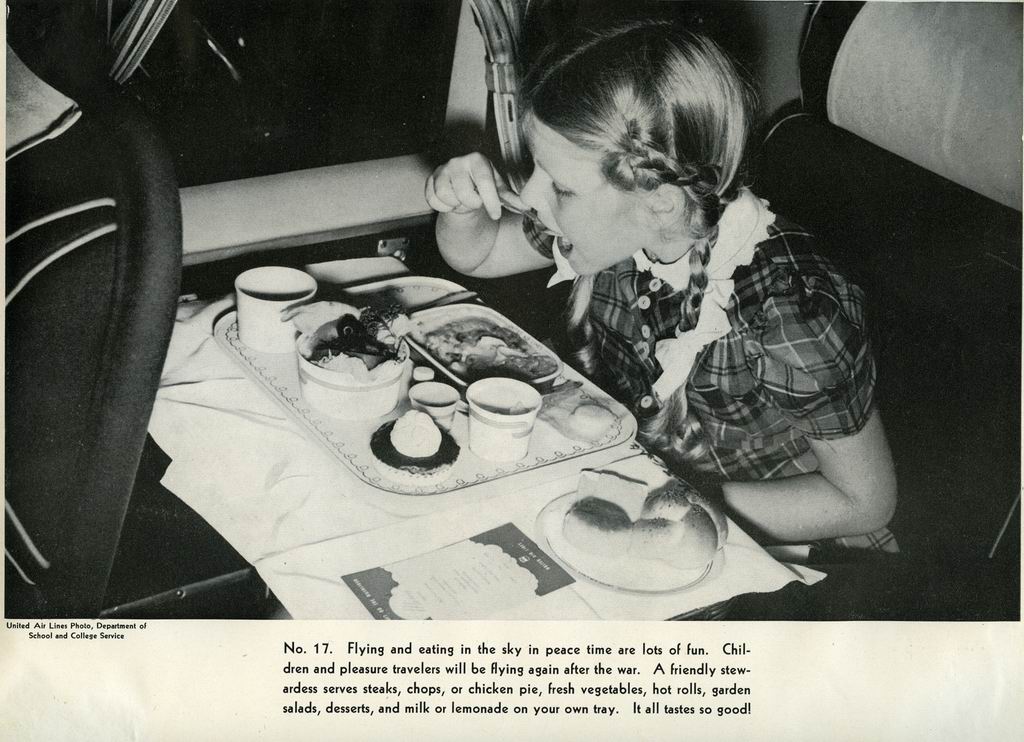
The food is so good even the kids love it.

Farewell, hope you had a good flight!

Thursday, November 12, 2009

She Married Adventure

   When I was in College, I bought a strikingly-bound book called "I Married Adventure" in a second hand store. It was written by Osa Johnson, a young Kansan woman who accompanied her husband, Martin on a series of adventures in Borneo, Africa and the Soloman Islands early in the last century. Besides being an author, Osa and Martin were early filmmakers, naturalists and photographers. For decades this dashing couple captured the public's imagination through their films and books of adventure in exotic, far-away lands.


The Martins studied the wildlife and peoples of East and Central Africa, the South Pacific Islands and British North Borneo. They explored then-unknown lands and brought back film footage and photographs, offering many Americans their first understanding of these distant lands.


Living for months at a time in the bush, the Martins often adopted monkeys for pets.


The Crew For a Trip From Nairobi Into The Congo.


The movies and photos the Martins brought back were often the first view that Americans had of these primitive peoples.


The 1940 film was released simultaneously with the book.


Osa was no slouch with a firearm, The Martins often had to face down wild animals trying to get the most exciting shots with their cameras.


Back at their Nairobi home, Osa shares ice cubes with the natives.


When Osa married she understood that Martin was not likely to provide a "normal" home life but she probably had no idea how different her life would be from other Kansas farmgirls. Even in the remotest parts of Africa she still made sure their safari suits were freshly-laundered and ironed.


The 1932 feature movie Congorilla resulted from the couple's fourth trip to Africa, and was the first movie with sound authentically recorded on the continent.


Osa with another pet.


Osa and Martin with two of their cameras.


Although their early expeditions were poorly funded and they travelled meagerly, as they made more money from their films, they were able to go in style later on. Martin designed this special filming safari vehicle for use on their third African trip.


"Home Sweet Home"


In 1932 the Johnsons learned to fly at the airfield in Osa's hometown of Chanute. Once they had their pilot's licenses, they purchased two Sikorsky amphibious planes, a S-39-CS "Spirit of Africa" and S-38-BS "Osa's Ark".


Osa at the controls.